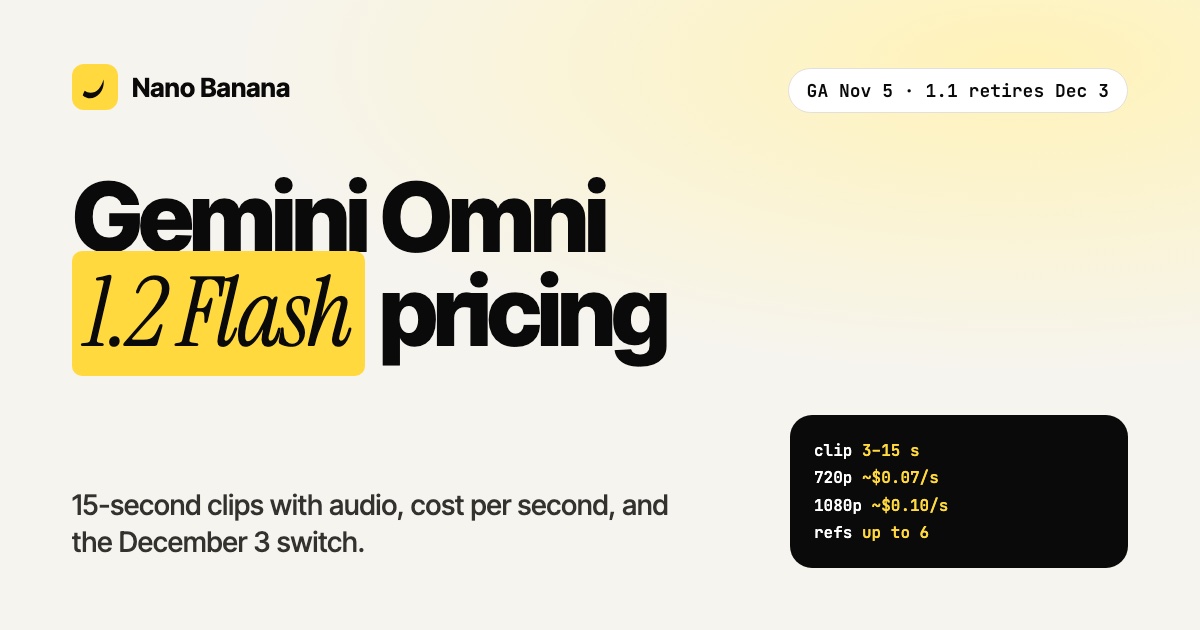
Google's Gemini Omni 1.2 Flash is now the default Gemini video model: clips of up to 15 seconds with audio, up to six reference images, and a lower price than 1.1. On December 3, 2026, requests to the old 1.1 model will be routed to 1.2 and billed at 1.2 rates. Here is what changed, what a clip really costs per second, and what developers need to do before the switch.
Gemini Omni 1.2 Flash in one minute
- Released: generally available on November 5, 2026, per the Gemini API changelog.
- API model ID:
gemini-omni-1.2-flash. - Inputs: text, images, audio and video. Output: video with audio, 24 fps, 360p to 4K.
- Length: 3 to 15 seconds per generation (10 seconds max on 1.1), extendable by 3 to 10 seconds per turn up to 30 seconds in total.
- Consistency: up to six reference images for characters and products.
- Price: $12 per million video output tokens, down from $17.50 on 1.1.
- Migration: from December 3, 2026, calls to the 1.1 model ID run on 1.2 and are billed at 1.2 rates.
Gemini Omni 1.2 Flash pricing
Google bills Gemini Omni by tokens, on the standard tier only (no free or batch tier for this model):
| Token type | Price per million tokens |
|---|---|
| Input (text, image, audio, video) | $1.50 |
| Text output | $9.00 |
| Video output | $12.00 (was $17.50 on 1.1) |
Converted to seconds of video, independent estimates (eesel's arithmetic from Google's token rates) give roughly:
| Resolution | Approx. cost per second | 15-second clip |
|---|---|---|
| 360p | $0.023 | about $0.35 |
| 720p | $0.07 | about $1.04 |
| 1080p | $0.104 | about $1.56 |
| 4K | $0.209 | about $3.14 |
Retries and extensions add up: a 30-second clip built from a 15-second generation plus extensions costs more than the sum suggests if you regenerate takes. Budget for two or three attempts per usable shot.
What's new compared with Gemini Omni 1.1 Flash
- Longer single clips: 15 seconds instead of 10, in one-second steps.
- Shorter total extension: 30 seconds maximum, down from the 40 seconds advertised for 1.1. Google does not explain the change.
- Better speech: clearer lip-sync and multi-speaker conditioning.
- Higher limits: paid-tier rate limits doubled.
- Google's own preference tests vs 1.1: 62% vs 38% on text-to-video visual consistency, 63% vs 37% on reference-to-video preference and identity consistency. These are Google's evaluations, not independent tests.
The December 3 migration: what developers should do
- Find every call to the 1.1 model ID in your code and pipelines.
- Re-test your prompts on
gemini-omni-1.2-flashnow: a new model can change framing, pacing and voices even with the same prompt. - Check long videos. If you relied on 40-second extensions, plan for the 30-second cap, or stitch clips on a timeline.
- Update cost estimates with the new token price, and switch explicitly rather than waiting for the automatic routing.
Where you can use it
Google lists the Gemini app, Gemini Enterprise, Google AI Studio, the Gemini API, Google Cloud, Flow, YouTube, Workspace and Google Vids (3 to 15-second slider). Every output carries an invisible SynthID watermark and C2PA Content Credentials.
If you compare video models for a project, our Gemini Omni video guide and the Seedance 2.5 vs MiniMax H3 comparison cover the main alternatives. MiniMax H3 and Seedance 2.5 both run in Nano Banana Video Studio, with editing on the same timeline.
FAQ
How long can a Gemini Omni 1.2 Flash video be?
3 to 15 seconds per generation, and up to 30 seconds in total with extensions of 3 to 10 seconds each.
How much does Gemini Omni 1.2 Flash cost per second?
About $0.07 per second at 720p and about $0.10 at 1080p, based on Google's $12 per million video output tokens.
What happens to Gemini Omni 1.1 Flash?
From December 3, 2026, requests to the 1.1 model ID are routed to 1.2 and billed at 1.2 rates.
Does Gemini Omni 1.2 Flash generate audio?
Yes, video comes with audio, including speech with improved lip-sync.
Sources: eesel, Gemini Omni 1.2 Flash review, citing Google's Gemini API changelog, pricing page and model card. Per-second costs are estimates; check Google's pricing page before budgeting. Status as of November 11, 2026.