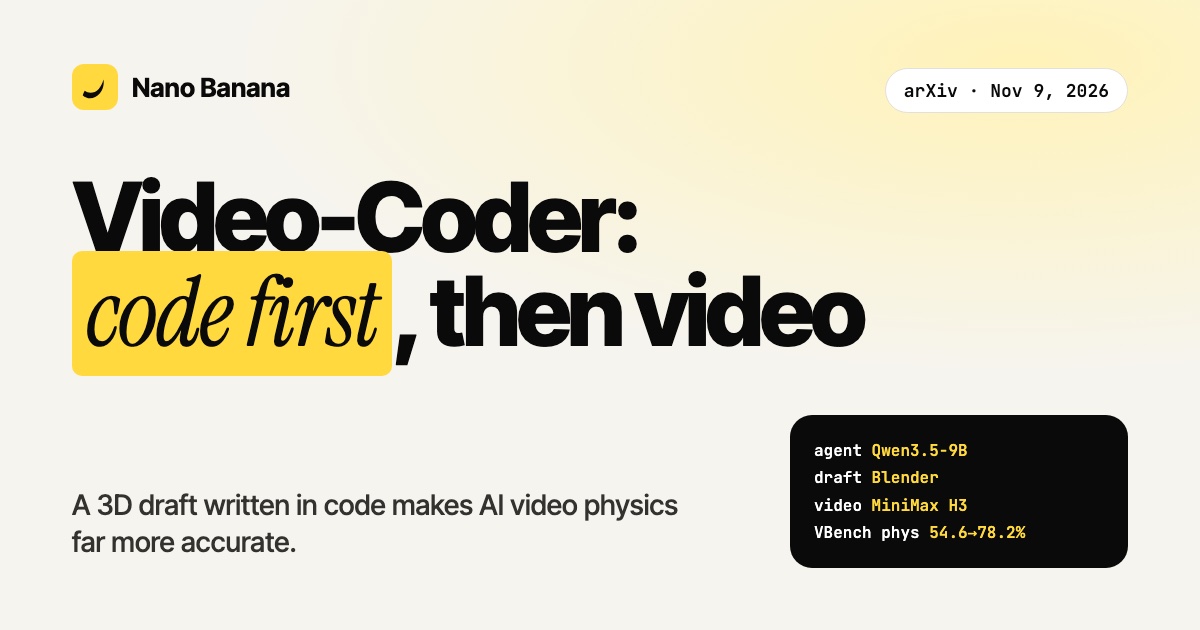
AI video models still get physics wrong: balls that float, liquids that pour upward, shadows that point the wrong way. A paper published on November 9, 2026, Video-Coder, tests a simple fix: before generating any pixels, let an AI agent write code that builds the scene in 3D, render a rough draft, and give that draft to the video model. On the authors' benchmarks, physical accuracy jumps sharply. Here is how it works, what the numbers say, and how you can use the same idea today.
Video-Coder in one minute
- Paper: "Video-Coder: Reinforcing Agentic Coding for Video Generation", arXiv 2611.09894, November 9, 2026.
- Authors: researchers from the University of Central Florida, Microsoft Research, Tsinghua University, the University of Würzburg, UNC-Chapel Hill and UW–Madison.
- Idea: an agent writes and runs Blender Python to build the scene, renders an untextured "Draft Video" with the structure and motion, then a video model (MiniMax H3 in the paper) turns it into the final clip.
- Agent model: Qwen3.5-9B, fine-tuned, then trained with reinforcement learning.
- Result: VBench-2.0 physical score from 54.58% to 78.19% when the draft is added to MiniMax H3.
Why AI video models struggle with physics
A diffusion video model learns what motion usually looks like, not why it happens. It has no explicit notion of mass, gravity or light paths, so it produces motion that looks plausible frame by frame but breaks the rules over a few seconds. Bigger models help, but they do not remove the problem. Video-Coder's bet is to split the job: let code handle what code is good at (geometry, timing, physics), and let the video model handle what it is good at (texture, light, realism).
How Video-Coder works
- Plan in code. The agent reads the prompt and writes a Blender Python script: objects, positions, camera, motion over time.
- Run and repair. The script runs. If it fails, the agent reads the error and fixes the code.
- Render a draft. Blender renders a plain, untextured Draft Video: shapes, motion and camera only.
- Generate the final video. The draft guides MiniMax H3, which adds the realistic look while keeping the motion.
The agent is trained in two stages: supervised fine-tuning on example scripts, then reinforcement learning (GRPO) with two rewards, one for code that runs and one for the quality of the final video, judged by a multimodal model. The execution reward fades over training, so the agent first learns to write working code, then learns to write code that makes good videos. Training took about 3 days on 8 H100 GPUs.
The results
| Benchmark | MiniMax H3 alone | Video-Coder-9B + MiniMax H3 |
|---|---|---|
| VBench-2.0, physical average | 54.58% | 78.19% |
| VBench-2.0, mechanics | 67.59% | 88.67% |
| PhyGenBench, average | 0.61 | 0.67 |
On PhyGenBench, the gains are spread across mechanics (0.68), optics (0.79), thermal (0.60) and materials (0.61). Removing either reward, or the reinforcement learning stage, lowers the score, which supports the authors' training design.
Keep the caveats in mind. This is a preprint, not a peer-reviewed paper. The numbers are the authors' own. The paper is not fully consistent (dataset sizes and the size of the PhyGenBench gain differ between sections), and MiniMax H3 is used both as the generator and as a reference in parts of the pipeline.
What it means for creators
The lesson is bigger than one paper: code is becoming a first step of AI video. Other October and November releases point the same way, from code-to-video research models to Anthropic presenting Claude Fable 5.2 as able to create animations and educational videos with sound in code.
You do not need Blender or a research cluster to use the idea today:
- For exact motion, skip pixels entirely. In Nano Banana Video Studio, Claude Fable 5.2 writes a 3D scene in code with its own sound, and your browser renders it to MP4. Timing, text and logos stay exact.
- For realism, generate with a video model such as MiniMax H3 or Seedance 2.5, and describe the physics explicitly in the prompt: weight, speed, direction, what touches what.
- Mix both on the same timeline: a coded 3D packshot or diagram, then realistic shots around it.
FAQ
What is Video-Coder?
A research method where an AI agent writes Blender code to build and animate a 3D draft of the scene before a video model generates the final, realistic clip.
Which video model does Video-Coder use?
MiniMax H3 in the paper. The draft-video approach could, in principle, guide other models that accept a video as input.
Is Video-Coder available to use?
It is a research paper (arXiv 2611.09894). Check the paper page for code and model releases.
How can I get physically accurate AI video today?
Use code-generated animation for anything that must be exact, such as product turntables, diagrams and data, and a video model for realistic scenes. Nano Banana Video Studio offers both in one editor.
Sources: Video-Coder on Hugging Face Papers (arXiv 2611.09894, November 9, 2026). Figures are reported by the authors and not independently verified; status as of November 11, 2026.